

Price: $2,459.99 $1,499.99
(as of 2026-10-20 05:20 GMT+0000 – Details)

Processor and AI Acceleration
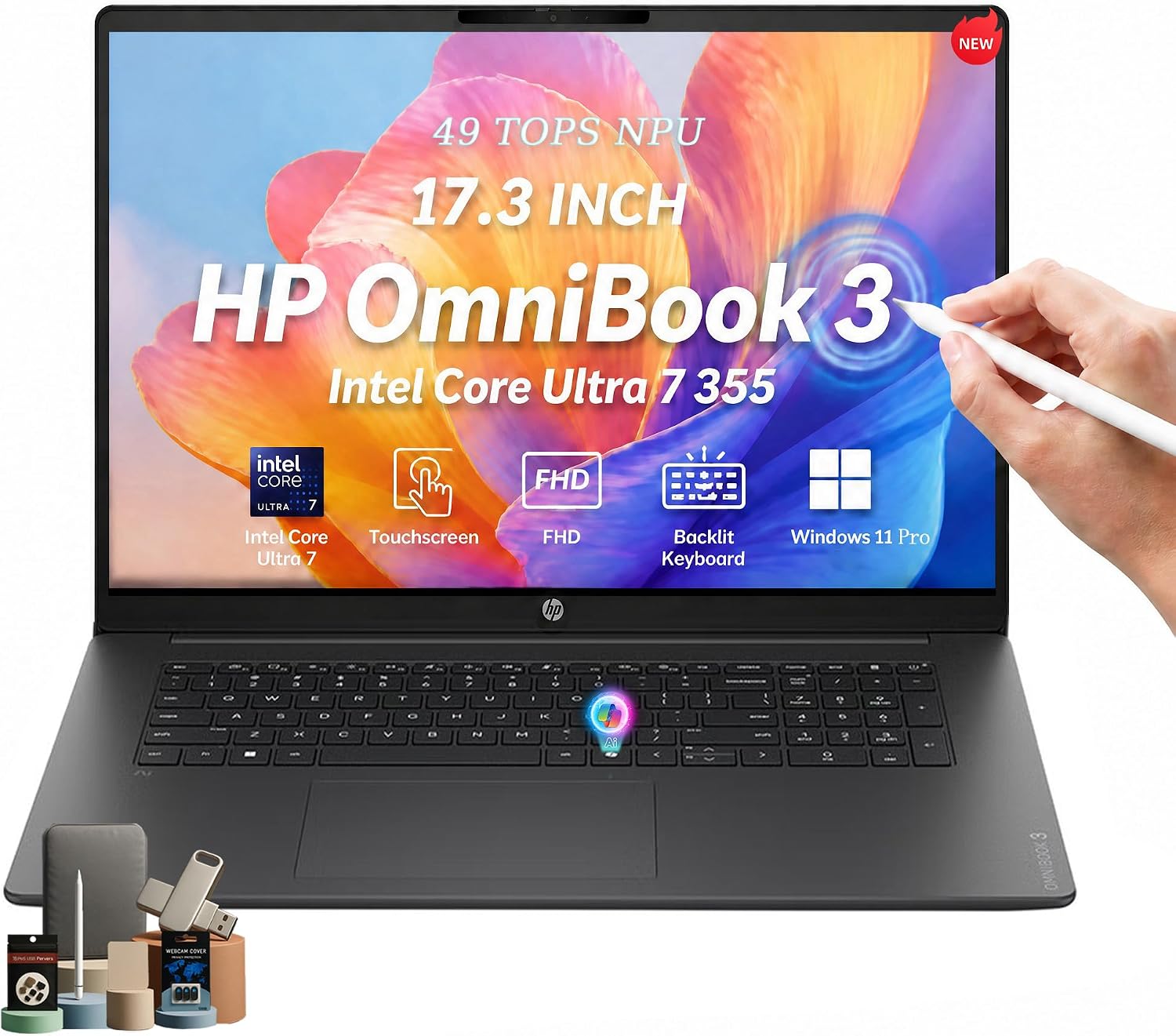
The HP OmniBook 3 is built around the Intel Ultra 7 355, an eight‑core processor that can reach a maximum turbo frequency of 4.7 GHz. Integrated Intel AI Boost provides a neural processing unit rated at up to 49 TOPS, enabling the laptop to qualify as a Copilot+ PC. In practice this means on‑device AI tasks such as real‑time transcription, image enhancement, and predictive text can run without cloud round‑trips, reducing latency and preserving privacy. The benefit is most noticeable in applications that have been optimized for the NPU; workloads that do not leverage the AI engine will rely solely on the CPU cores. Thermal headroom and sustained clock speeds will determine how long the NPU can operate at its peak rating during extended sessions.
Display and Touch Interaction
A 17.3‑inch Full HD IPS panel with a micro‑edge bezel delivers a 1920 × 1080 resolution at 300 nits brightness and an anti‑glare coating. The 10‑point multi‑touch capability adds a direct manipulation layer for scrolling, zooming, and inking, which can accelerate creative review or data‑entry workflows. The larger diagonal gives more screen real estate for side‑by‑side windows, reducing the need for virtual desktops. However, 300 nits may limit outdoor visibility in bright sunlight, and the FHD resolution on a 17‑inch panel yields a pixel density lower than smaller high‑DPI screens, so fine text may appear less crisp at close range.
Memory, Storage, and Multitasking Capacity
The platform ships in two configurable tiers: 16 GB or 32 GB of DDR5‑5600 memory paired with a 1 TB or 2 TB PCIe Gen4 NVMe M.2 SSD. The higher‑capacity option provides ample headroom for large datasets, virtual machines, and extensive media libraries, while the faster DDR5 bus improves bandwidth for integrated graphics and AI inference. The Gen4 SSD delivers sequential read/write speeds well above SATA limits, shortening application launch and file transfer times. Users who select the base 16 GB/1 TB configuration should verify that their typical workload fits within those limits, as the memory is not user‑upgradeable on many ultrabook designs.
Keyboard, Input, and Ergonomics
A full‑size, iron‑gray backlit keyboard includes a dedicated numeric keypad, catering to spreadsheet‑heavy tasks and data entry. Key travel and actuation force are tuned for a comfortable typing rhythm during long sessions, and the backlight aids low‑light environments. The layout follows the standard HP arrangement, so users migrating from other HP models will find familiar key placement. The touchscreen adds an alternative input method, but the glossy surface can attract fingerprints, potentially requiring frequent cleaning for optimal visibility.
Connectivity and Port Selection
Two USB‑C ports support 10 Gbps signaling, Power Delivery 3.1, and DisplayPort 1.4, allowing simultaneous charging, high‑speed data, and external 4K display output. Two USB‑A ports at 5 Gbps maintain compatibility with legacy peripherals, while a single HDMI 2.1 port can drive a 4K @ 120 Hz monitor. Wireless connectivity relies on Wi‑Fi 6 (2×2) and Bluetooth 5.4, which are adequate for typical office and home networks but lack the newer 6 GHz band of Wi‑Fi 6E. The port mix covers most docking scenarios without requiring an additional hub.
Camera, Privacy, and Windows 11 Pro Features
The 1080p FHD IR camera incorporates HDR auto‑switch, temporal noise reduction, and a physical privacy shutter. These features improve video‑call clarity in varied lighting and provide a hardware guarantee that the lens is blocked when not in use. Windows 11 Pro adds enterprise‑grade management tools such as BitLocker, Remote Desktop, and group policy support, which complement the AI‑enhanced collaboration features like automatic framing and background blur. The effectiveness of AI‑driven video enhancements depends on driver and application support, and the IR sensor enables Windows Hello facial recognition for secure login.
Physical Design, Battery, and Power Delivery
The chassis measures 15.64 × 9.18 × 0.65 inches and weighs approximately 4.43 lb, making it relatively portable for a 17‑inch class device. A 4‑cell 68 Wh lithium‑polymer battery powers the system, and the included 65 W USB‑C GaN adapter supports fast charging via Power Delivery. Real‑world battery life will vary with screen brightness, AI workload intensity, and peripheral usage; heavy NPU activity can reduce runtime noticeably. The slim profile limits internal expansion, so the memory and storage configurations are fixed at purchase.