


Price: $433.99 $259.98
(as of 2026-10-19 23:01 GMT+0000 – Details)

AI Assistance and Office 365 From the Start
The built-in AI assistant provides five clearly separated modes: Chat, Write, Read, Meet, and Draw. This structure makes the feature more practical for everyday study and productivity because tasks can be approached according to their purpose rather than through one generic interface. Write mode may help organize ideas or produce text, Read mode can assist with document-based work, and Draw supports visual tasks, while Meet and Chat cover communication-oriented uses. The description does not specify whether these functions require an internet connection, what data they can process, or how the assistant handles specialized assignments, so its capabilities should be understood from the five stated modes rather than assumed to extend further.
Office 365 is preinstalled with a one-year subscription included, removing the need to begin with separate software setup for common school and office tasks. This makes the laptop ready for document creation, presentations, and routine productivity work from the outset. The supplied information does not cover the subscription’s renewal price, included service levels, or what happens after the first year, so the current benefit is a full introductory year rather than an open-ended software entitlement. Together, the AI modes and bundled Office 365 suite provide the most immediately accessible features for a student-oriented system.
Everyday Performance and Expandable Storage
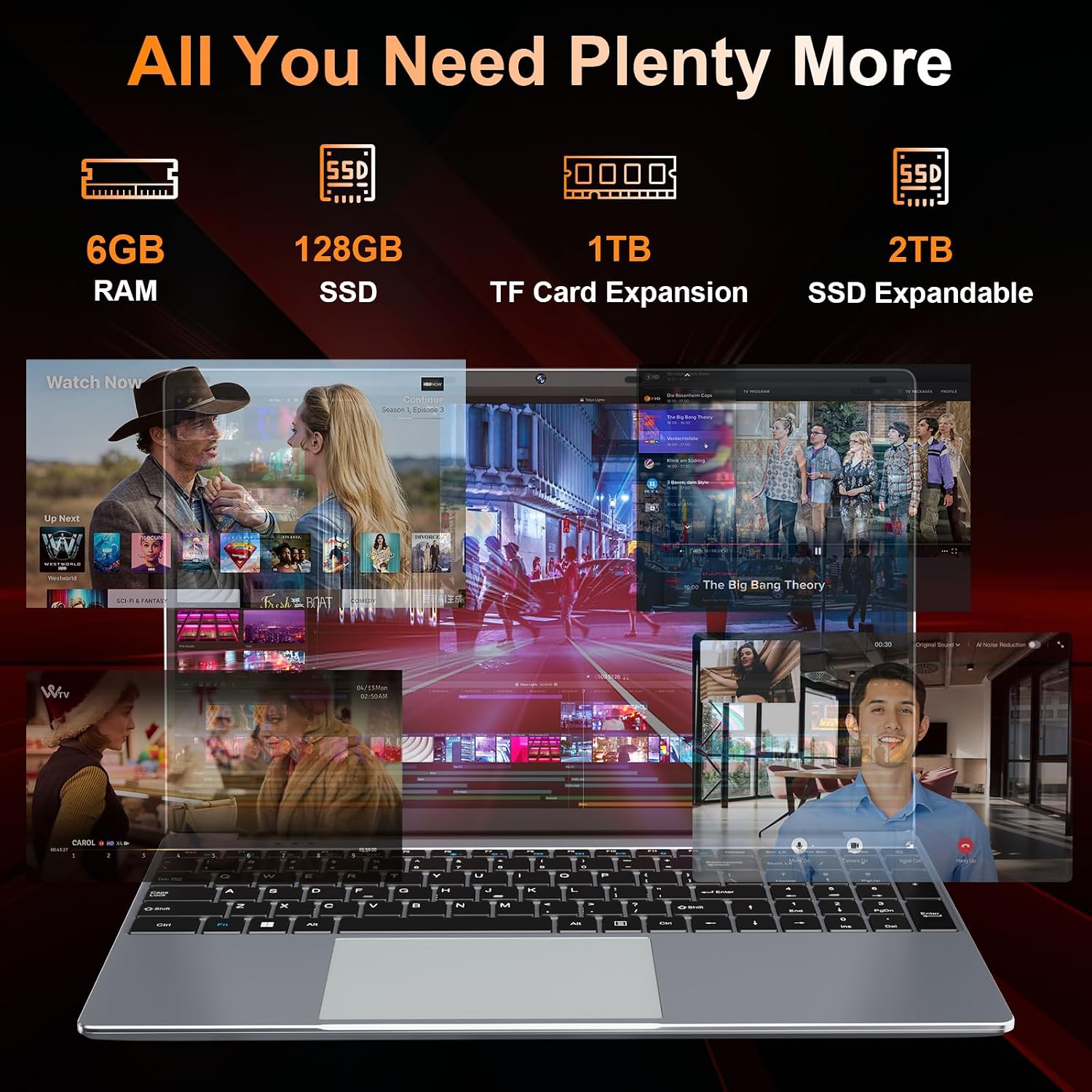
Performance is based on a Celeron J4105 quad-core processor, 6GB of RAM, and a 128GB SSD. This combination is positioned for everyday multitasking such as working with documents, browsing the web, joining online classes, and handling routine media. The SSD should support quicker file access than a comparable hard-drive-based system, while 6GB of memory gives the operating environment and active applications a reasonable amount of working space. However, no benchmark results or processor specifications beyond the chip name are provided, so the laptop is best viewed as a general-purpose student machine rather than a system for intensive video editing, advanced modeling, or other demanding workloads.
Storage begins at a relatively compact 128GB, which can become restrictive as documents, presentations, images, and other media accumulate. The stated expansion options address that concern by allowing storage to grow to as much as 2TB through an SSD or 1TB through a TF card. An internal SSD increase offers greater capacity for local files, while a TF card can provide a convenient removable option for moving media or coursework between locations. The description does not clarify whether both expansion paths can be used simultaneously, how many slots are available, or the precise speed of the added storage, so the stated limits are best treated as maximum supported capacities rather than a complete expansion diagram.
Battery Capacity and a Flexible 180-Degree Design
A 7000mAh battery is included and is described as supporting long classes and meetings, making battery endurance an important part of the laptop’s student-focused design. That capacity should be useful for extended periods away from a wall outlet, although the description provides no estimated runtime, charger wattage, or testing conditions. Actual duration will depend on screen brightness, wireless use, and the workload involved. For a full day of demanding use, the battery specification alone cannot guarantee a specific number of hours, but it indicates that sustained mobile work was considered when the system was designed.
The 180-degree rotating feature allows the display to lay completely flat, adding flexibility beyond a conventional fixed laptop position. Flat placement can make it easier to share a presentation, discuss material with classmates, or choose a viewing angle that suits the available space. It can also reduce the need to hold the screen at an uncomfortable angle during close collaborative work. The supplied information does not address the hinge’s durability, the number of intermediate positions, or whether every use case will benefit from a flat layout. Nevertheless, the lay-flat mechanism gives the laptop a practical form of physical adaptability for shared workspaces and different working postures.
Full HD IPS Display
The 15.6-inch display uses a 1920×1080 IPS panel, providing full HD resolution across a screen size that is substantial enough for study materials, web research, presentations, and streaming. IPS technology is noted for wide viewing angles, which is particularly useful when the screen is positioned for shared viewing rather than directly in front of one person. The narrow-bezel design maximizes the usable display area and gives the laptop a more contemporary appearance. Sharp detail and vibrant color are also stated benefits, making the panel well matched to ordinary educational and entertainment content.
Some display-related details are not included in the supplied specification, such as peak brightness, color accuracy, refresh rate, touch support, or the exact dimensions of the active area. Those omissions limit the extent to which the panel can be evaluated for specialized color-sensitive work or very bright outdoor use. For general classroom, office, and media viewing, the combination of full HD resolution, IPS viewing angles, and narrow bezels offers a clear practical advantage, while more demanding visual requirements would require additional technical information.
Ports and Wireless Connectivity
Port selection includes USB 3.2, USB Type-C, and Mini-HDMI, covering several common connection needs. USB can be used with compatible peripherals such as storage devices, input accessories, or network hardware, while Mini-HDMI provides a straightforward option for connecting an external display. Type-C adds another modern connection format for compatible accessories, although the description does not state whether it supports display output, charging, or any particular data-transfer standard. The total number of available ports is also unspecified, so users who expect several simultaneous accessories may need to plan for an additional hub or docking solution.
Wireless connectivity is handled through Wi-Fi 5 and Bluetooth 4.2, supporting connections at home, in the library, or while traveling. These standards cover everyday internet access and compatible Bluetooth peripherals, including headphones, keyboards, or mobile devices. The supplied information does not provide antenna specifications, supported security profiles, or real-world transfer rates. As a result, the connectivity package appears designed around practical everyday use, with a broad mix of wired and wireless options for a student laptop that may be used in multiple environments.
Overall Assessment
Overall, the laptop’s strongest combination lies in its student-oriented software, flexible 180-degree screen, 15.6-inch full HD IPS display, generous stated battery capacity, and multiple storage-expansion paths. The included AI assistant adds five distinct working modes, while the preinstalled one-year Office 365 subscription improves immediate readiness for common academic tasks. Connectivity is also reasonably varied for a portable system, with three port formats plus Wi-Fi 5 and Bluetooth 4.2. These features support a workflow centered on classes, documents, presentations, collaboration, and regular media use rather than specialized professional workloads.
The main constraints are the Celeron J4105 processor, 6GB of RAM, and initially modest 128GB of storage, which position the machine toward mainstream productivity rather than heavy computational work. Battery life, display brightness, keyboard, weight, and the full range of AI functions are not quantified in the supplied description, so they should not be treated as verified beyond the stated specifications. For students seeking an adaptable display, bundled productivity tools, and room to expand storage, the configuration is clearly designed to cover essential daily needs; those requiring intensive applications, maximum portability, or advanced connectivity may need to compare it with more specialized systems.