



Price: $649.95 $429.99
(as of 2026-10-19 23:00 GMT+0000 – Details)

Performance for Everyday Computing
The configuration is built around an AMD Ryzen 5 processor with four cores, eight threads, and boost speeds up to 3.7GHz. That is a credible platform for coursework, document editing, browser-based applications, and the routine compilation and debugging involved in introductory college coding. The supplied description specifically says the chip outpaces the Intel Celeron N4020 in PassMark CPU Mark multi-thread testing. No matching result is provided for the i5-1135G7 referenced in the product title, however, so that comparison cannot be quantified from the available information. Windows 11 Home supplies the familiar productivity environment, while 8GB of memory is adequate for typical schoolwork but can become a constraint in heavy browser sessions, virtual machines, or large software projects.
Graphics and the 15.6-Inch Display
Graphics are handled by integrated AMD Radeon Vega 8 hardware with eight graphics cores. Rather than a discrete GPU, this is intended for presentation visuals, streaming, family-photo viewing, blog layouts, and basic image editing, all of which align with the stated light-creator use case. It should not be read as a specification for demanding 3D rendering, high-end gaming, or intensive video work. The 15.6-inch FHD screen in a 16:9 format provides a practical canvas for slides, spreadsheets, documents, and media, and its roomy proportions should suit prolonged desk use better than a compact screen. Color coverage, brightness, and panel technology are not stated, so visual quality for color-critical editing cannot be judged from the supplied specifications alone.
Memory, Storage, and Upgradeability
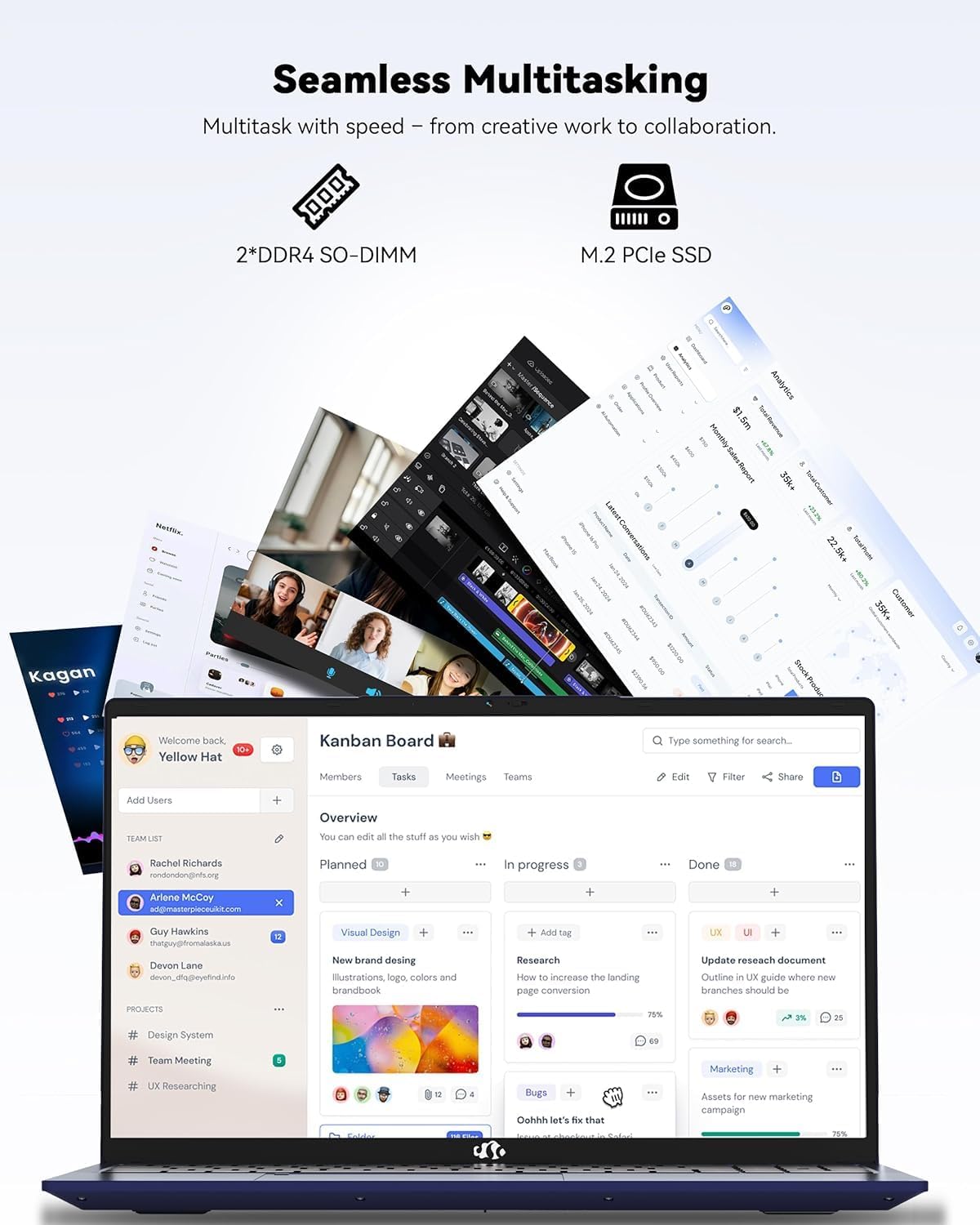
For storage and memory, the laptop starts with 8GB of DDR4 RAM and a 256GB SSD. The 256GB capacity is workable for an active semester of notes, documents, and applications, but may fill quickly if large coding repositories, media libraries, or game installations are added. The important flexibility is that two DDR4 SO-DIMM slots support expansion to as much as 32GB, allowing users to add memory as multitasking demands increase. A single M.2 PCIe 3.0 x4 2280 slot supports SSD upgrades up to 4TB, providing substantial room for coursework and project files without relying on external media. A MicroSD slot is also included for importing photos and keeping overflow files organized, although its presence does not replace the faster internal SSD for active work.
Daily Carry and Flexible Positioning
At 357.4 by 228 by 19.2mm and under 1.7kg, the chassis is positioned for daily movement between a dorm, library, home office, or shared workspace. The metal lid and plastic body keep the stated weight manageable while distinguishing the exterior surfaces, though the larger 15.6-inch footprint will occupy more bag space than an ultraportable. The approximately 175-degree hinge allows the display angle to be adjusted to different seated positions, which is useful on desks where a fully open posture is not always comfortable. This is a conventional productivity design rather than a convertible tablet, so the main benefit is flexible viewing in everyday laptop modes. Buyers who routinely travel with minimal luggage should still compare the dimensions with their available bag space.
Backlit Keyboard and Fingerprint Access
The backlit US-layout keyboard is a practical addition for evening note-taking, email, and extended writing in dim rooms. It retains familiar English key positions and common shortcuts, while illumination makes labels easier to locate without changing the layout. A fingerprint reader integrated into the touchpad adds a quick route into Windows after stepping away from a study session or shared desk, reducing repeated password entry when enrolled. Its placement combines pointer control and sign-in access in the same compact area, and the touchpad also provides the pointing surface users need when a mouse is not connected. The fingerprint feature is best treated as a daily convenience that complements, rather than replaces, normal account-security practices.
Ports, Charging, and External Connections
Connectivity covers several common peripheral needs. There are three USB-A ports—two USB 3.2 Gen 1 and one USB 2.0—so a mouse, flash drive, and external storage can be connected without a large hub in many cases. Two USB-C ports are also present: one is dedicated to 65W Power Delivery charging, while the other is full-function and listed for PD, DisplayPort, charging, and data with compatible peripherals. HDMI 1.4, MicroSD, and a 3.5mm headset jack round out the selection. The included 65W adapter uses a US plug, accepts 100–240V AC input, and includes a 2-meter cable. The 11.4V, 4700mAh lithium-polymer battery has a calculated nominal capacity of about 53.58Wh. Exact simultaneous display support is not specified, so docking arrangements should be checked against the included ports and device requirements.
Warranty, Support, and Intended Use
Ownership is backed by a two-year manufacturer warranty, a 90-day hassle-free return window, USA assembly, and USA-based after-sales replacement support. Those provisions are relevant to students and remote workers purchasing a portable PC for long-term daily use because they add a stated service path beyond the hardware itself. Specification-wise, the configuration is aimed at general college productivity, remote office work, introductory coding, and light content creation. The upgradeable RAM and storage make it easier to extend that usefulness over time. At the same time, the product title references AI and an i5-class comparison, while the detailed specifications list neither a dedicated AI accelerator nor direct i5 benchmark figures; demanding AI models, professional creative software, and graphics-intensive workloads would require more capable hardware than is documented here.